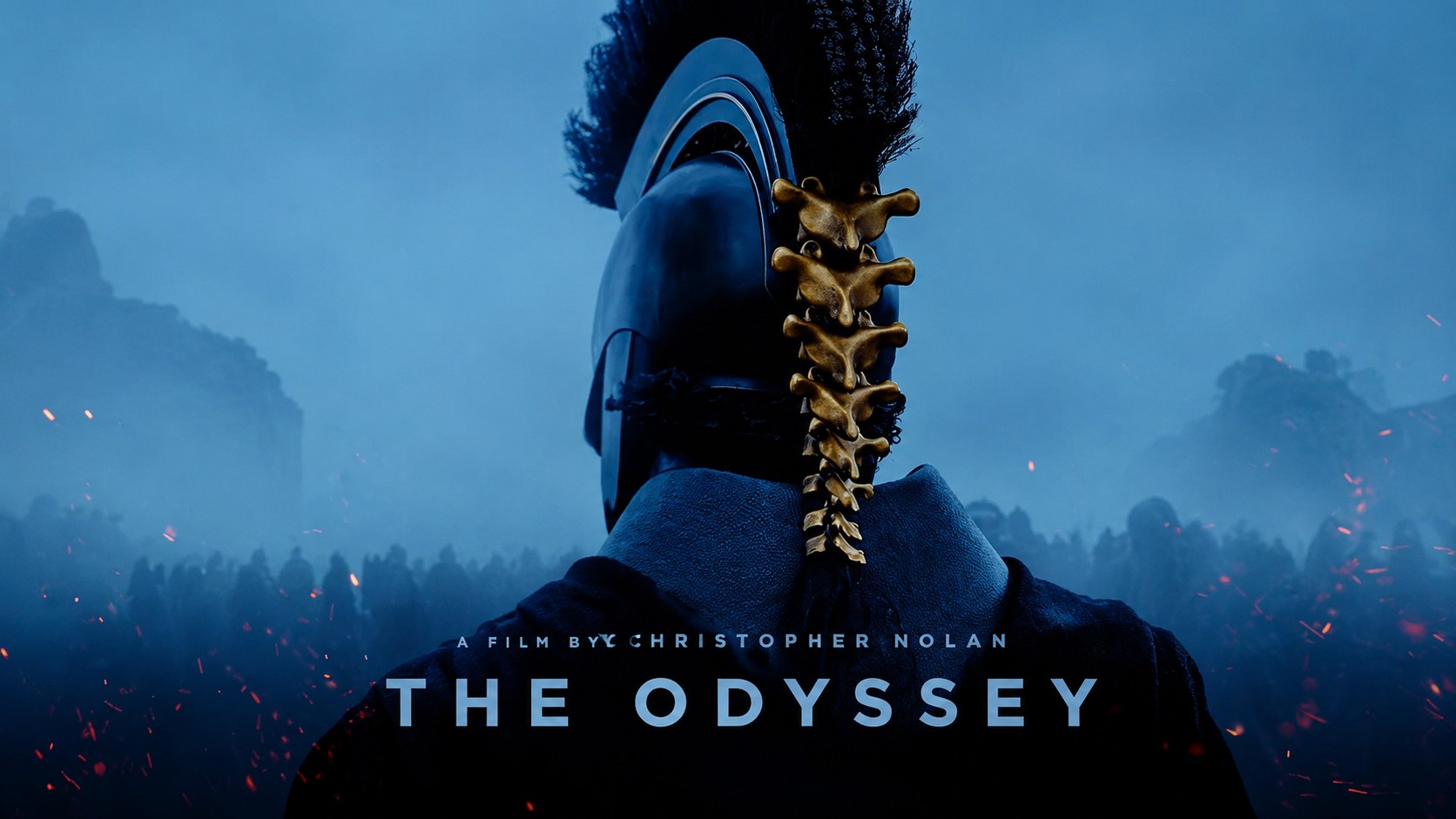
Christopher Nolan’s Odysseus, an adaptation of the Homeric epic for the silver screen, presents a colossal narrative of cosmic justice where humanity pays the price for sins committed in the intoxication of victory, rather than merely glorifying a conventional myth of heroism. The central motif of the film is the direct violation of the cosmic order—the pillage carried out by the Achaeans in Troy, exploiting trust and the sacred under the guise of a holy gift and offering.
The massacre that unfolds behind the Walls of Troy is not merely the destruction of a mortal city; it is a grave violation of the Universal Law (Logos) and Zeus’s order (Dike). As Marcus Aurelius emphasizes in his Meditations, the principle of justice is intrinsically tied to the divine essence:
“He who acts unjustly commits impiety. Because universal nature has created rational beings not to harm one another, but to benefit one another. Therefore, anyone who violates this will clearly sins against the oldest of the gods.” [1]
Through the ruse of the Trojan Horse, the Achaeans exploit not only their enemies but also the sacred law of Zeus Xenios, the god of friendship and hospitality. The moment divine righteousness is transgressed, the curse that descends upon the Achaeans begins. Nolan depicts the fall of Troy not as a moment of triumph, but as a dark breaking point where cosmic imbalance (Apeiron) breaches its limit (Peras).
1. Peras, Apeiron, and the Reality of the “Sea Peoples” Myth
In pre-Socratic philosophy, particularly in Anaximander, the universe rests upon a delicate balance between Peras (limit, measure, form) and Apeiron (boundlessness, indeterminacy, chaos). The foundational principles of the ancient world, Meden Agan (Nothing in excess) and Metron Ariston (Measure is best), are utterly disregarded with the sacking of Troy.
This unbridled ambition (Hubris) of the Achaeans opens the door to one of the film’s deepest historical and philosophical readings: The Sea Peoples.
The enigmatic “Sea Peoples” sweeping across Mediterranean civilizations in the background of the film are not unknown invaders from the outside. They are the Achaeans themselves, who disrupted the cosmic balance by violating Zeus’s law, becoming slaves to their boundless ambitions and lust for pillage, alongside the Trojans who were barbarized after the destruction of their homeland. Having lost their sense of measure (Sophrosyne) and gone astray by shattering the order, these multitudes have transformed into a wave of Apeiron (excess), carrying ruin wherever they go. Cosmic justice (Dike) renders man the victim of the very law he breached: Those who destroyed Troy with lawless greed plunged the entire Mediterranean world into darkness through the barbarism they mutated into.
2. The Source of Evil: Plato, the Qur’an, and the Demons of Our Own Making
The reality that man engineers his own destruction and that evil stems not from God, but from human greed, is a shared focal point of both Eastern and Western thought.
In the famous Myth of Er in his Republic, Plato absolves God of evil while explaining that souls choose their own destinies and ways of life:
“The blame belongs to him who chooses; God is blameless.” [2]
According to Plato, the ‘Idea of the Good’ is the sole source of goodness; evil is a disease that man produces within his own constitution through his intemperance (Akrasia), injustice (Adikia), and boundless desires.
This universal truth resonates with equal certainty in celestial revelation. The Qur’an expresses how man corrupts the cosmic and social order with his own hands:
“Corruption has appeared on land and sea because of what the hands of people have earned. Thus, Allah makes them taste a part of what they have done, so that perhaps they will return.” [3]
And in another verse, the source of evil is directly attributed to humanity:
“Whatever affliction befalls you is because of what your own hands have earned…” [4]
The Achaeans, who chose pillage and the exploitation of the sacred in Troy, actually lived the cosmic principle pointed out by Plato and the Qur’an: Evil and darkness are not an arbitrary wrath of Zeus or fate; they form a hell that man constructs with his own hands by abandoning Sophrosyne.
3. The Mirror of Cyclops Polyphemus and the Bestialized Man on Circe’s Island
The Achaeans’ violation of universal law confronts Odysseus as a mirror at every stop on his journey. In Homer’s text, when Odysseus enters the cave of the Cyclops Polyphemus, he expects to be hosted according to hospitality (Xenia) and the law of Zeus. Odysseus addresses the Cyclops as follows:
“We are suppliants protected by Zeus… Host us in the name of Zeus Xenios, who protects strangers and guests.” [5]
However, the cold response of Cyclops Polyphemus strikes like a slap to Odysseus, who destroyed a city by violating sacred hospitality and trust in Troy:
“You are a fool, O stranger! We Cyclopes care nothing for aegis-bearing Zeus, nor for the other sacred gods; for we are much stronger than they are. I would not spare you or your comrades out of fear for the wrath of Zeus…” [6]
This lawlessness of the Cyclops is, in fact, the very embodiment of the attitude displayed by Odysseus and the Achaeans in Troy. A mentality that tramples upon the sacred has long forfeited the right to expect divine law in the cave it seeks refuge in. The Cyclops is the profile of a one-eyed, one-dimensional man who cares for nothing but power and materiality.
The zenith of this moral collapse occurs on Circe’s island.
When Circe magically turns Odysseus’s men into swine, Odysseus begs her to restore them to human form. Circe’s response summarizes the philosophical core of the film:
“Look at those creatures interrupting our conversation, Odysseus. I only changed their outer shell. Were they not already swine when they arrived here?”
Circe’s island is filled with “bestialized” humans who have lost their inner Sophrosyne (measure, self-control, spiritual balance) and become slaves to their passions and ambitions. The moment man distances himself from reason and virtue, regardless of his physical appearance, he spiritually morphs into a beast.
Indeed, Aristotle, in his Politics, describes the state to which man descends when he breaks away from moral boundaries:
“Man, when separated from virtue and law, is the most savage and the worst of creatures; he is the lowest in lust and gluttony.” [7]
While Aristotle notes that intemperance and uncontrolled ambitions turn human nature into cattle and wild beasts, Epictetus harshly criticizes the masses trying to crush each other in city squares:
“…For to bite one another (daknein), to revile, and to occupy the marketplace (agora) as wild beasts occupy the mountains is not a conduct fitting for the human mind/nature.” [8]
4. The Possibility of Happiness Without Dike (Justice), Logos (Reason), and Virtue
In his Republic, Plato emphasizes that the greatest catastrophe within the human soul is disharmony and injustice. According to Plato:
“The worst, most pitiable traits of man are injustice [Adikia] and intemperance [Akrasia]. A person who bears this corruption in his soul is a slave, even if he possesses all the spoils of the world.” [9]
The Achaeans who sacked Troy thought they had achieved victory, but they had actually signed off on their spiritual ruin. It is because of this violated law that Agamemnon was murdered by his most trusted confidants, and Odysseus’s home was invaded by suitors, defiling his privacy and the law of hospitality.
The plain truth stated by Aristotle in the Nicomachean Ethics haunts Odysseus throughout the film:
“It is impossible for man to be happy [Eudaimon] without virtue [Arete].” [10]
Odysseus may have brought down Troy through his intellect (Metis); however, an intellect severed from virtue and Logos drags a person not to happiness, but to years of loneliness, exile, and an internal hell.
5. The Utopian Prison of Forgetting and the Return to Truth: Anamnesis
Perhaps one of the most tragic turning points of the film is Odysseus withdrawing from time and memory on Calypso’s [Circe’s] island, seeking a false happiness through “forgetting.” As long as Odysseus is willing to eat the lotus fruit and erase his past from his mind, he remains in the paradise-like prison on the island. However, the moment he chooses to remember (Anamnesis) the sins he committed in Troy, his true identity, and his assigned mission, the path to Ithaca—his divine homeland—is opened. Forgetting is comfort; but remembering is liberation.
This narrative perfectly aligns with the philosophical architecture Plato constructed in his Republic to explain the exile of the human soul in the world. According to Plato, when the soul falls into the sensory world (the cave), it drinks from the River of Unmindfulness (Lethe), severing its connection to truth, and forgets its original homeland, the realm of ideas [11]. This is the sole reason why man becomes lost, bestialized, and stripped of his purpose in this world. The salvation of the soul and its return to its “divine homeland” is only possible through the process of recollection (Anamnesis). When Odysseus rejects the sweet numbness of the lotus fruit and embraces his tragic past, he initiates his journey back to his celestial homeland in a Platonic sense.
6. The Bankruptcy of Intellect and Stoic Surrender: From Metis to Epictetus’s Prayer
The finale of Odysseus’s journey is another philosophical triumph in terms of grasping human limitations. Odysseus’s renowned human intellect (Metis), cunning, and strategic calculations, which brought down Troy, prevented him from returning home for years. On the contrary, the more he clung to his own mind and arrogance, the more he was tossed about the seas, suffering the wrath of cosmic justice. What allows him to reach Ithaca is his surrender to the cosmic will of the sea and the gods, at the very point where human calculations completely bankrupt themselves.
The submission of human’s petty will to the Universal Law (Logos) and destiny sits at the very core of Stoic philosophy and Epictetus’s teachings. Epictetus, in his Enchiridion (The Handbook), recalls the famous prayer of Cleanthes:
“Lead me, O Zeus, and you too, O Destiny! Lead me wherever you have ordained for me.” [12]
When Odysseus sets aside his proud cunning from Troy and arrives at this point of surrender described by Epictetus; that is, when he yields to the flow of the divine will, the sea delivers him to the shore. Nolan’s cinematography whispers a profound wisdom here: What brings a man home is not his arrogant intellect trying to subjugate the universe, but his alignment with the path ordained by fate and God.
Conclusion
Christopher Nolan’s Odysseus presents a heavy philosophical lesson to audiences fond of epics of triumph. The stark truth the film underscores is this: No victory achieved by trampling over divine laws, hospitality, trust, and measure goes unpunished. The Universal Law (Logos) will, sooner or later, pull everything that overflows into excess (Apeiron) back within its limits (Peras).
The Achaeans and Trojans, who exploited the sacred in Troy for the sake of Helen—who, despite her beauty, was ultimately nothing more than a mere object of desire, her beauty marred by a simple wound—pay their price by mutating into the continent-ravaging “Sea Peoples,” by turning into swine on Circe’s island, and by finding themselves helpless in the cave of the Cyclops. Nolan reminds us of the ancient world’s timeless warning: The man who loses his virtue and measure is condemned to become the victim of the barbarian within himself.
Bibliography of Footnotes and Original Texts
[1] Marcus Aurelius, Meditations, Book IX, Section 1.
«Ὁ ἀδικῶν ἀσεβεῖ. τῆς γὰρ τῶν ὅλων φύσεως κατεσκευακυίας τὰ λογικὰ ζῷα ἕνεκα ἀλλήλων… ὁ οὖν ταύτην τὴν βούλησιν παραβαίνων ἀσεβεῖ δηλονότι εἰς τὴν πρεσβυτάτην τῶν θεῶν.»
“He who acts unjustly commits impiety. Because universal nature has created rational beings not to harm one another, but to benefit one another… Therefore, anyone who violates this will clearly sins against the oldest of the gods [the Divine Law].”
[2] Plato, Republic, Book X, 617e.
«…ἀρετὴ δὲ ἀδέσποτον, ἣν τιμῶν καὶ ἀτιμάζων πλέον καὶ ἔλαττον αὐτῆς ἕκαστος ἕξει. αἰτία ἑλομένου· θεὸς ἀναίτιος.»
“…Virtue is masterless; whoever honors or dishonors it will have more or less of it. The responsibility and the blame belong to him who chooses; God is blameless [remains without responsibility].”
[3] Qur’an, Surah Ar-Rum, Verse 41.
«ظَهَرَ الْفَسَادُ فِي الْبَرِّ وَالْبَحْرِ بِمَا كَسَبَتْ اَيْدِي النَّاسِ لِيُذ۪يقَهُمْ بَعْضَ الَّذ۪ي عَمِلُوا لَعَلَّهُمْ يَرْجِعُونَ»
“Zaharal-fasâdu fî-l-berri vel-bahri bimâ kesebet eydî-nnâsi liyuzîkahum ba’da-llezî ‘amilû le’allehum yerji’ûn.”
“Corruption/disorder (fasad) has appeared on land and sea because of what the hands of people have earned [the evils and sins]. Thus, Allah makes them taste a part of what they have done, so that perhaps they will return [from their errors].”
[4] Qur’an, Surah Ash-Shura, Verse 30.
«وَمَٓا اَصَابَكُمْ مِنْ مُص۪يبَةٍ فَبِمَا كَسَبَتْ اَيْد۪يكُمْ وَيَعْفُوا عَنْ كَث۪يرٍۜ»
“Vemâ esâbekum min musîbetin febimâ kesebet eydîkum ve ya’fû ‘an kesîr.”
“Whatever affliction befalls you is because of what your own hands have earned [your own acquisitions]. Yet, He pardons much.”
[5] Homer, Odyssey, Book 9, Lines 269-271.
«ἀλλ’ αἰδεῖο, φέριστε, θεούς· ἱκέται δέ τοί εἰμεν. / Ζεὺς δ’ ἐπιτιμήτωρ ἱκετάων τε ξείνων τε, / ξείνιος, ὃς ξείνοισιν ἅμ’ αἰδοίοισιν ὀπηδεῖ.»
“But fear the gods, O mighty one; we are suppliants who have sought refuge at your door. Zeus is the protector of suppliants and strangers; he is Zeus Xenios (the Hospitable Zeus), who always walks beside venerable strangers.”
[6] Homer, Odyssey, Book 9, Lines 273-278.
«νήπιός εῖς, ὦ ξεῖν’, ἢ τηλόθεν εἰλήλουθας, / ὅς με θεοὺς κέλεαι ἢ δειδόμεν ἢ ἀλέασθαι· / οὐ γὰρ Κύκλωπες Διὸς αἰγιόχου ἀλέγουσιν / οὐδὲ θεῶν μακάρων, ἐπεὶ ἦ πολὺ φέρτεροί εἰμεν· / οὐδ’ ἂν ἐγὼ Διὸς ἔχθος ἀλευάμενος πεφιδοίμην / οὔτε σεῦ οὔθ’ ἑτάρων, εἰ μὴ θυμός με κελεύοι.»
“You are a great fool, O stranger, or you have come from very far away, to bid me fear the gods or shrink from them! We Cyclopes care nothing for aegis-bearing Zeus, nor for the other blessed gods; for we are much stronger than they are. I would not spare you or your comrades to avoid the wrath of Zeus; I will do only as my own heart bids!”
[7] Aristotle, Politics, Book I, 1253a31-33.
«ὥσπερ γὰρ καὶ τελεωθεὶς βέλτιστον τῶν ζῴων ἄνθρωπός ἐστιν, οὕτω καὶ χωρισθεὶς νόμου καὶ δίκης χείριστον πάντων… ἄνευ γὰρ ἀρετῆς ἀνοσιώτατον καὶ ἀγριώτατον…»
“For as man, when perfected, is the best of animals, so, when separated from law and justice, he is the worst of all… A man devoid of virtue is the most unholy and savage of creatures…”
[8] Epictetus, Discourses, Book II, Chapter 22, 26-28.
«…οὐ γὰρ κρίμα ἐστὶν ἀνθρώπειον τὸ δάκνειν ἀλλήλους καὶ λοιδορεῖσθαι καὶ τὴν ἐρημίαν ἔχειν καὶ τὴν ἀγορὰν ὡς ὄρη τὰ θηρία καὶ τὰ δικαστήρια ὡς λῃστήρια…»
“…For to bite one another (daknein), to revile, to occupy the marketplace (agora) as wild beasts occupy the mountains (orē ta thēria), and to turn the courts of justice into robbers’ dens is not the result of a judgment fitting for the human race; this is the consequence of the loss of virtue in man.”
[9] Plato, Gorgias, 477e – 478a / Republic, Book IV, 444b-e.
«…ἀρετὴ μὲν ἄρα, ὡς ἔοικεν, ὑγίειά τέ τις ἂν εἴη καὶ κάλλος καὶ εὐεξία ψυχῆς, κακία δὲ νόσος τε καὶ αἶσχος καὶ ἀσθένεια.»
“…Virtue, then, as it seems, would be a kind of health, beauty, and good condition (euexia) of the soul; whereas vice (kakia) is its disease (nosos), its ugliness (aischos), and its weakness (astheneia).”
[10] Aristotle, Nicomachean Ethics, Book I, 1098a16-18.
«…εἰ δ’ οὕτως, τὸ ἀνθρώπινον ἀγαθὸν ψυχῆς ἐνέργεια γίνεται κατ’ ἀρετήν, εἰ δὲ πλείους αἱ ἀρεταί, κατὰ τὴν ἀρίστην καὶ τελειοτάτην.»
“…If this is so, the human good (the highest good) becomes the activity of the soul in accordance with virtue;”
[11] Plato, Republic, Book X, 621a-b. (The Myth of Er – Lethe and Anamnesis)
«…ἀφικνέεσθαι εἴς τι πεδίον, τὸ τῆς Λήθης… πίνειν μέτρον: τὸν δὲ ἀεὶ πινόμενον πάντων ἐπιλανθάνεσθαι. ἀναμνησθέντα δὲ σῴζεσθαι…»
“…They arrived at a certain plain, that of Forgetting (Lethe)… Each one was obliged to drink a certain measure of this water; those who drank forgot everything. But those who remembered (Anamnesis) were saved…”
[12] Epictetus, Enchiridion (The Handbook), Chapter 53 (Quote of Cleanthes’ Prayer).
«Ἄγου δέ μ’, ὦ Ζεῦ, καὶ σύ γ’ ἡ Πεπρωμένη, / ὅποι ποθ’ ὑμῖν εἰμὶ διατεταγμένος: / ὡς ἕψομαί γ’ ἄοκνος· ἢν δέ γε μὴ θέλω / κακὸς γενόμενος, οὐδὲν ἧττον ἕψομαι.»
“Lead me, O Zeus, and you too, O Destiny! Lead me wherever you have ordained for me. I will follow without hesitation. Even if I yield to my will and am reluctant, like a wicked man, I will follow you nonetheless.”
About The Author
