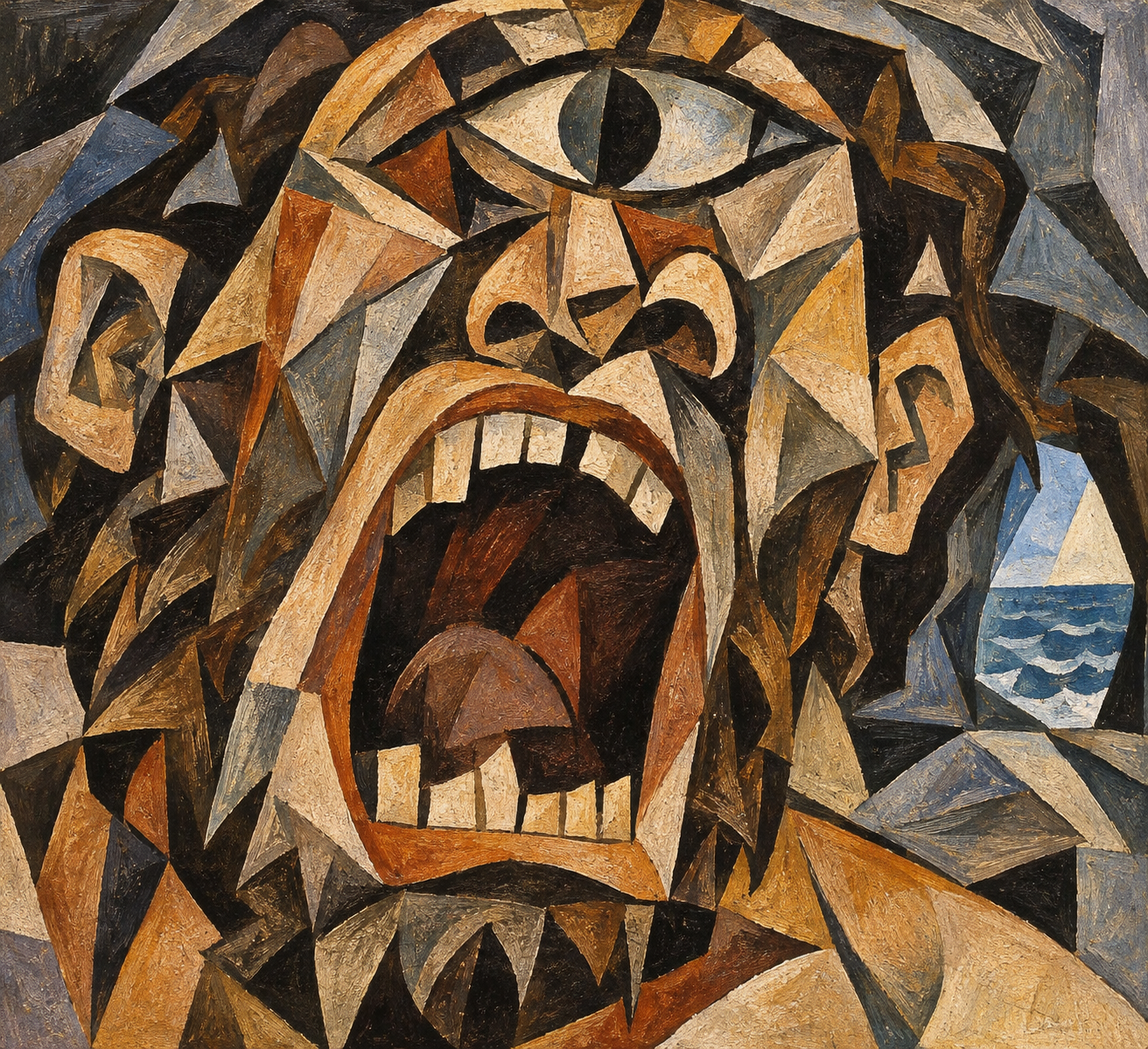
After enduring numerous misfortunes, Odysseus and his companions continue their journey and eventually arrive on the island of the Cyclopes.
Homer describes the Cyclopes as “arrogant and lawless” — ὑπερφιάλων ἀθεμίστων.
The word ὑπερφίαλοι (hyperphialoi) denotes those who are excessive, arrogant, insolent, and unrestrained. ἀθέμιστοι (athemistoi) signifies those who lack themis: those who recognize neither law, custom, nor legitimate order.
Homer continues:
“They have neither assemblies for the making of decisions nor established laws.”
These arrogant and lawless beings live according to their own whims, without participating in any shared social or political order.
When Odysseus and his men set out to explore the island, they enter one of the Cyclopes’ caves. The cave is filled with cheeses and young lambs. Although his companions wish to take some of the provisions and depart, Odysseus hopes to encounter the owner of the cave as a guest and receive the customary gifts of hospitality — ξείνια (xeinia).
They therefore remain in the cave, awaiting its owner.
The owner is Polyphemus, a one-eyed giant. Upon returning and discovering the uninvited visitors, he addresses them:
“Strangers, who are you? From where have you sailed across the sea? Are you travelling on some business, or do you wander aimlessly, like pirates who risk their lives upon the seas and bring misfortune upon strangers?”
Odysseus replies:
“We are Achaeans, driven off course on our return from Troy…”
He then expresses his expectations, attempting to establish a moral foundation for their encounter:
“But, mighty one, show reverence for the gods, for we have come to you as suppliants. Zeus is the protector of suppliants and strangers; Zeus Xenios watches over those who seek hospitality.”
Yet the one-eyed giant Polyphemus responds:
“You are a fool, stranger, or else you have come from very far away, if you tell me to fear the gods or stand in awe of them. The Cyclopes care nothing for aegis-bearing Zeus or the blessed gods, for we are far stronger than they.”
The Polyphemus portrayed by Homer is an immoderate, arrogant, and unrestrained being. He recognizes no customary order. Nor does he acknowledge the authority of the gods.
He trusts entirely in his own strength.
He is physically formidable and lives amid an abundance sufficient to satisfy all his needs. Indeed, the island is so fertile that its inhabitants have no need to cultivate the land; their livestock and the natural abundance surrounding them provide everything they require.
And this monstrous giant intends to devour Odysseus and his companions.
Why?
Because he is stronger than they are, and for Polyphemus the supreme law is “the law of the stronger” — τὸ τοῦ κρείττονος δίκαιον.
Odysseus overcomes this law of brute strength through wisdom, or more precisely through μῆτις (mêtis): cunning intelligence. He blinds Polyphemus, depriving him of the ability to see the world.
Within an esoteric interpretation of the Odyssey, the one-eyed Polyphemus can be understood as symbolizing a particular human type: the arrogant, excessive, materialistic, tyrannical worshipper of power who perceives the world exclusively through the perspective of physical strength and brute force.
We encounter a striking development of this interpretation approximately three centuries after Homer, in Euripides’ satyr play Cyclops (Κύκλωψ).
Euripides’ Polyphemus declares, almost as though announcing a philosophical doctrine:
ὁ πλοῦτος, ἀνθρωπίσκε, τοῖς σοφοῖς θεός
Approximately:
“Wealth, little man, is god to those who are wise.”
He proceeds to proclaim his indifference toward Zeus, explaining that his cave provides him with everything he needs and that his flocks sustain him.
More strikingly still, he elevates his own belly to the status of a deity.
He declares that he offers sacrifices to no one but himself and his stomach. For the wise man, he argues, the true “Zeus” consists in eating and drinking abundantly every day, while remaining free from all anxiety.
Thus, in Euripides, Polyphemus becomes an explicit representation of those who think of nothing beyond their stomachs, their appetites, and their immediate desires; those who offer sacrifices only to themselves and worship money and wealth as gods.
What makes this contrast even more remarkable is that Odysseus represents almost the exact opposite of Polyphemus.
Against the giant’s overwhelming physical strength, Odysseus possesses μῆτις (mêtis): calculating, adaptive, versatile intelligence.
Polyphemus inhabits a world defined by power, possession, and consumption.
Odysseus inhabits a world defined by vision, understanding, language, and strategy.
Odysseus defeats Polyphemus through intelligence.
In doing so, he initially exercises control over his ego. When the monster asks his name, he introduces himself as “Nobody” — Οὖτις (Outis).
He defeats the giant by becoming Nobody, by withdrawing his ego and concealing his identity.
Yet as he sails away from the island, he becomes intoxicated by his own victory. Driven by the desire for glory, he succumbs to his ego and shouts:
“Cyclops! If any mortal ever asks you how your eye was so shamefully blinded, tell him that it was Odysseus, the sacker of cities, who blinded you: the son of Laertes, whose home is in Ithaca.”
This momentary act of arrogance, however, will condemn him to years of wandering across the seas, far from his intended destination.
This episode is one of the most powerful moments in which Odysseus can be interpreted through the Greek concept of ὕβρις (hybris).
For Odysseus has already escaped.
Through the suspension of his ego, his intelligence, patience, and mêtis (μῆτις), he has defeated Polyphemus, led his companions out of the cave, and returned to his ship.
Yet precisely when he has reached safety, his desire to proclaim his victory and immortalize his name overwhelms his prudence.
Modern classical philology has frequently interpreted this challenge as a moment of hybris, excessive self-confidence, or a failure of self-restraint.
To translate ὕβρις (hybris) merely as “pride” or “arrogance” is insufficient.
In archaic and classical Greek, the concept encompasses a broader range of meanings:
- The transgression of proper limits and measure;
- The individual’s forgetfulness of his own limitations;
- The humiliating display of power over others;
- The violation of boundaries through intoxication with success.
When Odysseus crosses this boundary, calamity begins.
Returning to Polyphemus, the Cyclops who is the central subject of this essay, we encounter a remarkably similar allegory many centuries later in the writings of Jalāl al-Dīn Rūmī (Mevlânâ).
In the Masnavi, Book IV, verses 1709–1715, Rūmī explicitly declares:
با دو دیده اول و آخر ببین
هین مباش اعور چو ابلیس لعین
“See the beginning and the end with two eyes;
Beware of becoming one-eyed like the accursed Iblis.”
He then directly explains what it means to be “one-eyed”:
اعور آن باشد که حالی دید و بس
چون بهایم بیخبر از بازپس
“The one-eyed is he who sees only the present moment;
Like the beasts, he remains unaware of what comes afterward.”
Even more striking is the example that follows:
چشم خر چون اولش بی آخرست
گر دو چشمش هست حکمش اعورست
“The donkey’s eye sees the beginning but not the end;
Though it possesses two eyes, it is nevertheless judged to be one-eyed.”
For Rūmī, therefore, possessing two physical eyes is not sufficient to make a human being truly two-eyed.
If a person thinks only in terms of the present moment, personal advantage, pleasure, the body, and the visible world, that person is, in reality, one-eyed.
The donkey, a figure associated with worldliness and limited perception in numerous traditional symbolic systems, becomes a particularly powerful expression of this one-dimensional vision in Rūmī’s verses.
Interestingly, classical Islamic eschatological narratives also describe the Dajjāl (al-Dajjāl), the great deceiver who will appear before the end of time, as one-eyed.
A prominent narration preserved in Sahih al-Bukhari states:
مَا بَعَثَ اللَّهُ مِنْ نَبِيٍّ إِلَّا أَنْذَرَ قَوْمَهُ الأَعْوَرَ الْكَذَّابَ، إِنَّهُ أَعْوَرُ، وَإِنَّ رَبَّكُمْ لَيْسَ بِأَعْوَرَ
“Allah has sent no prophet without his having warned his people against the one-eyed liar. He is one-eyed, whereas your Lord is not one-eyed.”
Here we encounter a particularly significant convergence:
الأَعْوَر (al-aʿwar): one-eyed; having a defective eye.
الْكَذَّاب (al-kadhdhāb): the great liar; the inveterate deceiver.
Thus, defective vision and deception are united within the same figure.
The Dajjāl’s problem is not merely that he cannot see properly.
Rather, although his own vision is deficient, he claims to possess the truth and seeks to convince others that he sees reality as it truly is.
In this way, a bridge emerges between the wisdom narrative that begins with Homer in ancient Greece and the spiritual and philosophical traditions that have continued into our own age.
To worship physical strength and the body alone is to reduce the human being to a one-dimensional monster. In the figures of Iblis and the Dajjāl, this reduction can even assume the symbolic form of the demonic, transforming man into something beastlike or devilish.
Against such monstrous human types, however, one may prevail through intelligence freed from ego, patience, and strategic cunning.
Millennia may pass, civilizations may rise and fall, and the languages through which humanity expresses its wisdom may change.
Yet the traps into which human beings fall, the enemies they encounter, and the victories they achieve continue to repeat themselves with every human being born into this world.
About The Author
